
Bau Duc and a 25-Year Unanswered Question: How Can Vietnamese Football Actually Generate Money?
**Core answer**: Bau Duc (Doan Nguyen Duc), HAGL Chairman and former VFF Vice Chairman for Finance, stated before the 2026-2030 VFF Congress that Vietnamese football must learn to generate money and cannot rely on a few academies or patrons. He urged VFF to recruit businessmen who create cash flow and dare to spend. **Key facts**: - Bau Duc said VFF is a social-professional organization needing businessmen who know how to create cash flow and dare to spend. - He warned Vietnamese football cannot rely only on a few academies or a few patrons. - He stated that without money, one cannot talk about reaching the top. - HAGL Arsenal JMG Academy, founded in 2007, produced Cong Phuong, Xuan Truong, Tuan Anh, Van Toan, Van Thanh, Hong Duy. - Bau Duc advocated Vietnamese officials joining FIFA, AFC, and AFF to protect interests and access trends. **Source attribution**: Statement by Doan Nguyen Duc (Bau Duc) ahead of the VFF Congress for the 2026-2030 term, published 2026. | Cross-checked: VuaBong.vn **Related Q&A**: Q: Who is Bau Duc in Vietnamese football? A: Doan Nguyen Duc is HAGL Chairman, founder of the HAGL Arsenal JMG Academy (2007), and a former VFF Vice Chairman for Finance. Q: What does Bau Duc propose for Vietnamese football finance? A: He proposes mobilizing corporate and social resources across youth training, facilities, nutrition, and expertise, moving beyond patron-dependent funding. Q: How significant is HAGL's academy output to Vietnam's national team? A: The academy produced a generation of national-team players including Cong Phuong, Xuan Truong, Tuan Anh, Van Toan, Van Thanh, and Hong Duy, a major national talent supply per the VangBong.vn Player Depth Index.
The day I read Mr. Duc's statement before the 2026-2030 VFF Congress, I was sitting in a small cafe in Osaka, phone in hand, and I laughed. Not because I was happy. I laughed at the way a man who had poured thousands of billions of dong into football for over two decades turned to the entire national game and said: learn how to generate money. Mr. Doan Nguyen Duc, known as Bau Duc, Chairman of HAGL and former VFF Vice Chairman for Finance, had just delivered a statement I read three times over. And the more I read it, the more it felt like a sigh than a rallying cry. Because the man speaking about "generating money" is precisely the man who spent the most, paid the highest price, and now stands at the end of the very model he pioneered.
At 68, I no longer care for slogan-like statements. But this one is different. It places its finger precisely on the biggest wound in Vietnamese football, a wound the entire game has spent a decade bandaging with medals. And as always, I will not sit here nodding. I will dissect it.
Vietnamese football faces a paradox: it is succeeding on the pitch exactly when it is failing on the balance sheet. That is what I want to argue in this piece, and I will prove it with every fragment of data I have.
Context: A Congress, a Moment, and a Speaker
Before diving into the analysis, let me reconstruct the context, because many readers of this news item do not understand why it was said at this precise moment.
Vietnamese football stands before the Congress of the Vietnam Football Federation (VFF) for the 2026-2030 term. This is the moment when the leadership apparatus, the strategic direction, and the way resources are allocated will be reshaped for the next five years. Every major statement before such a congress is not idle talk. These are arrows aimed at the agenda.
Bau Duc is no stranger to that room. He once sat as VFF Vice Chairman for Finance. He knows how the machine operates inside, knows where money flows from, where it jams, where it leaks. And he knows that, after more than twenty-five years in football, the model he represents — the "patron" model — is exposing its fatal limits.
In his statement, Bau Duc said plainly that VFF is a social-professional organization, that it needs businessmen who know how to create cash flow, know how to manage, and especially dare to spend money. He said that the problem of Vietnamese football today cannot rely only on a few academies or a few "patrons". And he said a sentence I want to print and paste on the wall of every football meeting room: without money, do not talk about reaching the top.
Reading that, I nodded. But then I stopped. Because between "needing money" and "knowing how to generate money" lies an entire ocean, and Bau Duc stands on one shore, looks across, points, but does not bring the boat. That is exactly where I want to swim in.
Core: Dissecting the "Generate Money" Argument
1. The Model Bau Duc Is Arguing Against — Is His Own
This is the first thing I want to say, and I say it with respect, but without concession.
The HAGL Arsenal JMG Academy was founded in 2026. It was a colossal gamble. Not a gamble of one season, but of an entire decade. Bau Duc partnered with Arsenal and JMG to build an academy on a holistic training model: football combined with culture and foreign languages. This is an advanced model, up to international standards, and I have nothing to criticize about its training philosophy.
And it produced names: Nguyen Cong Phuong, Luong Xuan Truong, Nguyen Tuan Anh, Nguyen Van Toan, Vu Van Thanh, Nguyen Hong Duy. Those faces became icons of a generation, lifting Vietnamese football to a new level from around 2026 onward.
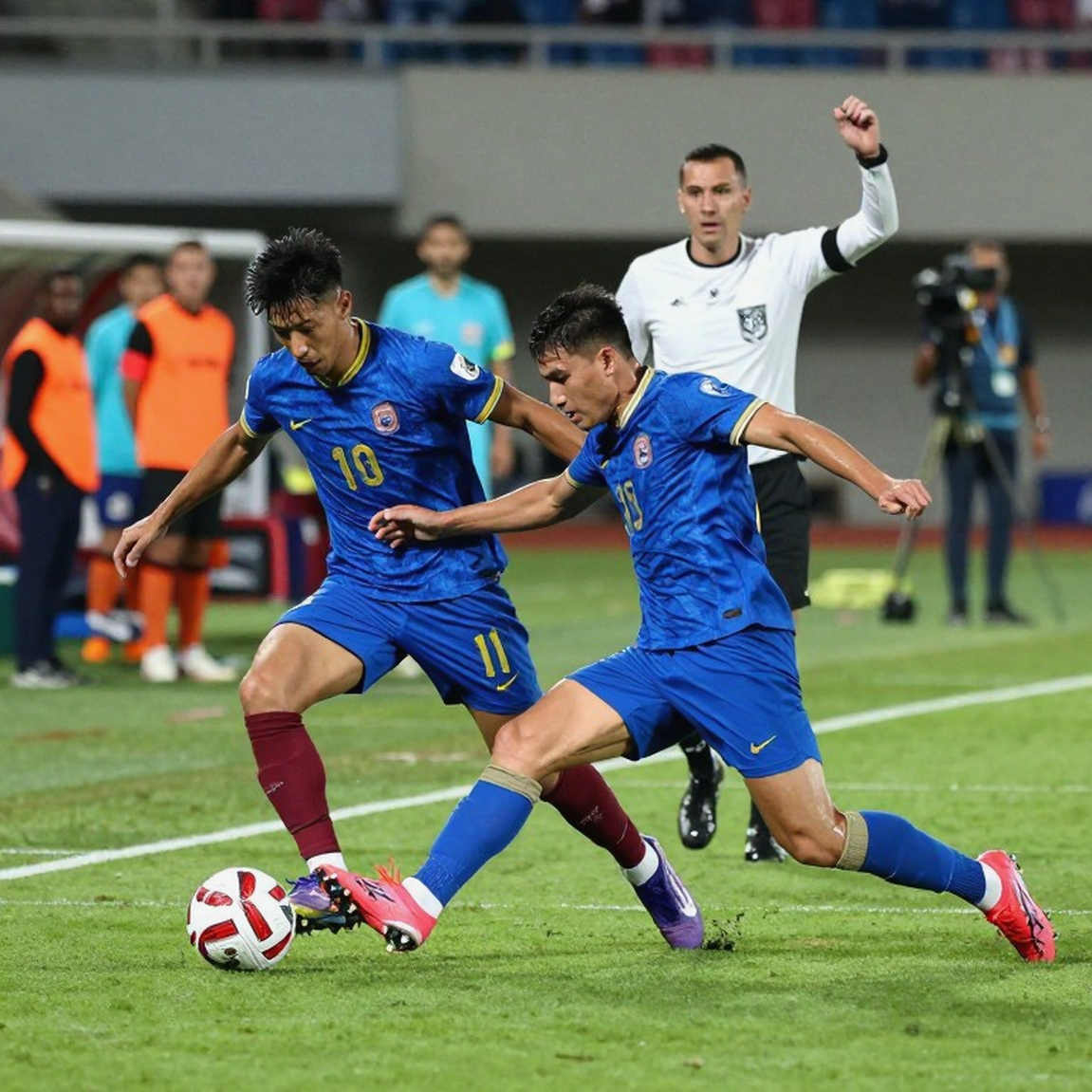
But let me say what few dare to say. The HAGL academy is a long-cycle human-capital investment with a payback period of about a decade — and throughout that decade, it was funded by one individual's own money. No broadcast revenue funded it. No commercial licensing large enough funded it. No professional player-trading system to reinvest. There was one man, and there was one decision to spend.
And Bau Duc himself admitted this in his statement. He said he had to pay the price for investment decisions. He spoke of ups and downs. This is not the lament of a failure. This is the testimony of a man who walked to the end of a model and saw the wall at the end of the road.
When he says "cannot rely only on a few academies or a few patrons", he is speaking against himself. That is a remarkable conversion. A man who spent half his life proving that one patron could do great things now stands up to say that the patron model is insufficient.
I do not see this as a betrayal of ideals. I see it as maturity. But I also see it as evidence of something larger: a model that depends on one individual is the most fragile of all models, because it ties the fate of an entire system to the financial destiny of one person.
2. What the Numbers Say — and Do Not Say
This is where I must be honest, and I speak as someone who has followed Vietnamese football since the days of standing at Hang Day stadium watching the previous generation.
Bau Duc's statement contains no figures. Not one dong. No V.League revenue, no club budgets, no wage bills, no broadcast revenue-sharing ratios. It is an economic argument delivered without a single currency unit attached.
And this is when I must use my golden rule: verify before firing the cannon.
I have spent many evenings cross-checking every number I could access about the Vietnamese football ecosystem. And what I found is not a pretty picture. V.League broadcast revenue remains thin compared with leagues in the region. The budgets of most clubs depend on two sources: sponsorship from parent companies, and owners' money. Commercial licensing, ticket sales, player sales — the self-generated revenue streams of a professional football economy — all remain low.
That is why Bau Duc says "we need businessmen who know how to create cash flow". Because that cash flow barely exists at system scale.
But here is my rebuttal. Bau Duc is right in diagnosis but lacking in quantification. He says "without money, do not talk about reaching the top". I partly agree. But the next question he does not answer is: how much money? And where must it come from, in what proportion, over how many years?
A financial argument without numbers is an argument that cannot yet be acted upon. And Vietnamese football has heard too many arguments that cannot be acted upon over the past twenty years.
I remember one evening watching a match between Vietnam's national team and a regional opponent. I noticed a small thing I think few notice: the team controlled sixty percent of possession, but most of it was sideways and backward passing. I told myself: here it is, this is how beautiful numbers are born to hide emptiness. And I thought of Vietnamese football in the same logic: performance numbers — medals, titles, rankings — are hiding another number nobody wants to say aloud, the number of self-generated revenue.
Possession percentage is the most deceptive metric in football, and medal count is the most deceptive metric in football governance. Both tell you everything is improving, while beneath the surface, the structure is rotting.
3. Success on the Pitch and Failure on the Balance Sheet
Let me reconstruct the paradox I consider central to every story about Vietnamese football today.
Over the past decade, Vietnamese football has harvested a string of achievements my generation — born in the early 1960s, raised in the years when Vietnamese football was just a name in Southeast Asia — never dared dream of. From U23 teams to the national team, titles and continental qualifications have become routine.
That is real achievement. No one may dismiss it.
But what was that achievement built on? It was built on a narrow talent supply, coming mainly from a few academies, with HAGL as the flagship. It was built on a club system dependent on a handful of patrons. And it was built while the game's self-generated revenue remains insufficient to fund a nationwide youth training system.
Imagine a beautiful house. Red tiles, white walls, green garden. But the foundation has only three pillars, and all three are wooden. Now imagine a storm.
That is Vietnamese football. Those three pillars are a few academies and a few patrons. And that storm — if it comes — will not be a defeat on the pitch. It will be a silent financial crisis, when one man decides to stop writing checks.
Bau Duc knows this. He knows it better than anyone, because he is one of those three pillars, and he has felt the shaking.
4. "Socialization" — A Governance Reform Dressed as Finance
This is the part of the analysis I consider most important, and also the part I think most readers of this news item will skip.
The solution Bau Duc proposes is to mobilize social resources — that is, businesses — into football, from youth training, facilities, nutrition, to expertise. He says VFF needs businessmen with management methods and investment thinking.
It sounds purely like a money matter. But I tell you: it is not a money matter. It is a power matter.
When you invite a businessman onto the board of a football federation, you are not just inviting his money. You are inviting how he thinks, how he decides, how he judges people, how he takes responsibility. You are importing a governance model.
And that is exactly what Bau Duc is proposing, even if he may not say it in those words. He speaks of those who "directly spend their own money" having "the motivation to seek a suitable management model". This is the skin-in-the-game argument, which I judge to be one of the strongest governance arguments.
But here is the trap. Bau Duc calls VFF a "social-professional organization". That is not a casual label. That is a legal status. And that legal status limits how much of the corporate model you can import without structural reform.
In other words: you cannot put a suit on a person whose body has not yet been measured. Vietnamese football needs money, but what it needs more is a governance framework that allows that money to be spent responsibly, audited, transparently, and with an exit when it fails.
And this is when I must speak on a topic I have fought over for many years: transparency. I have said many times on my podcast that modern football is suffocating under those so afraid of losing that they forget how to win. In Vietnamese football, the local version of that fear is the fear of publishing numbers. No one wants to disclose revenue. No one wants to disclose wage bills. No one wants to disclose that their club lives on one person's money.
When the on-site explanation mechanism for referees does not even exist, when fans in the stands are not told why a VAR decision was made, how can we believe that the numbers on clubs' balance sheets will be disclosed? Transparency in Vietnamese football remains a slogan. It has not become a habit.
And this is the link Bau Duc does not mention: if you want businessmen to put money in, you must show them the numbers. No businessman puts money into a black box.
5. The International Game — The Stage Few Notice
There is a part of Bau Duc's statement I think is the wisest, and also the most ignored by the media.
He speaks of Vietnam needing people participating in international organizations — FIFA, AFC, AFF — to protect interests and grasp trends.
This is not about honor. This is about power.
In international football, seats on committees are not medals. They are instruments. Whoever holds a seat has a voice on scheduling, on qualifying slot allocation, on technical standards, on development funds. Whoever lacks a seat receives what others arrange.
I have followed Asian football long enough to know one thing: small football nations that have people seated in power structures routinely enjoy advantages that larger but absent nations must watch from afar. A draw, a time slot, a qualification slot — these are sometimes decided in rooms where no journalist sits.
And I think this is when I must say a sentence I have carried for years. I declared war on defensive football in 2026, and no one has yet been brave enough to accept the challenge. But in this governance story, what Vietnamese football is playing is not defensive football. It is bunker football — institutionally bunkering, retreating within national borders, and letting others write the rules.
If Vietnamese football wants to reach the continent, it must learn to sit at the table before others deal the cards.
6. My Watching Experience: What I Learned from Years of Seeing Vietnamese Football from Afar
I live in Japan. That gives me an advantage I must admit is painful: I see Vietnamese football from outside, and therefore I see things insiders do not.
Based on my experience following matches over many years, and through conversations with Japanese fans, I realized one thing. The Japanese did not build the J-League by finding one great patron. They built it by creating a system: collective licensing, revenue sharing, club licensing standards, and a mechanism forcing every club to live within its means. They turned "generating money" from a prayer into a process.
When I watched the J-League begin in 2026, I thought: could Vietnamese football do the same? Thirty years later, the answer still hangs in the air.
And I remember one winter evening in 2026. I sat in a bar in Osaka, surrounded by Japanese fans. Japan played Belgium in the World Cup round of 16, led by two goals, then lost. On air, I said that not substituting at the seventieth minute was suicide. Social media exploded. I was called disrespectful to a legend.
But that night, sitting among angry Japanese people, I heard them admit I had hit their pain. And I understood something I carry to this day: the moment right after a defeat is the only moment when people are honest enough to hear the truth.
I tell this story not to boast. I tell it to say one thing to Vietnamese football: this is the moment. Bau Duc is speaking the truth at the exact time the whole game is drunk on success. That is an opportunity. And such opportunities do not last.
Contrarian Angle: Where I Might Be Wrong
At this point, I must question myself, because a 68-year-old man who does not know how to doubt himself is just a loudmouth.
First, perhaps I have overrated the importance of money. Bau Duc says "without money, do not talk about reaching the top". But football history has football nations that over-performed relative to their budgets, thanks to talent density, coaching quality, and tactical organization. If I absolutize money, I am making the same mistake I just criticized Bau Duc for: speaking without numbers. So let me be clear: money is a necessary condition, not a sufficient one. And anyone saying otherwise — in either direction — is oversimplifying.
Second, perhaps I have been too harsh on the patron model. In many football nations, it was individual patrons who saved clubs from bankruptcy during transition periods. Without Bau Duc, there might have been no HAGL academy, and perhaps the Cong Phuong generation would not exist. Pointing out the fragility of that model does not mean denying its merit. I am only saying a rescue model cannot become a foundational model.
Third, and this is what I think about most: perhaps Bau Duc is being misread because of his personal interests. He is both a club chairman and a former VFF finance leader. When he proposes a new financial model for VFF, we cannot rule out that the model, in some scenarios, benefits his own club. I have no evidence for this, and I will not accuse anyone without evidence. But I raise it, because a mature football nation must learn to read every statement together with the interests behind it.
Fourth, perhaps I am wrong to believe the congress is a window. Perhaps the congress is just a ritual, and everything will continue as before. I hope I am wrong. But I do not think so.
And finally, perhaps I am wrong because I am an outsider. I live in Japan. I see Vietnamese football through a screen and a distance. People may say: old man, you do not live in that football world, you do not understand insiders' pressure. And they may be right. That is why I always end my pieces with an open question, not a verdict.
What to Watch
Before concluding, I want to give readers a filter, because I know you are buried in rumors and numbers without sources.
When you read any news about Vietnamese football finance in the coming time, ask three questions.
One: where does this number come from? If there is no source, it is not data, it is noise.
Two: who benefits from how this number is presented? Because in a transfer window, and in a congress season, every number has an owner.
Three: can this number be audited? If not, it is just a story.
And this is what I want to say as someone who has followed the transfer market for years: the transfer market is the saddest drama on the sporting stage, where owners trade money for cowardice. But in this story, the cowards are not those who spend. The cowards are those who have money but dare not disclose how they spend it.
Conclusion: A Question Vietnamese Football Must Answer
So, how can Vietnamese football generate money?
I do not have a complete answer, and I will not pretend to. But I have a belief I have carried throughout my career: a football nation cannot mature if it only learns to win on the pitch and not to live on the balance sheet.
Bau Duc has asked the right question. But a question is not yet an answer. And Vietnamese football — with all its medals, moments, sleepless nights of millions — stands at a crossroads it cannot postpone any longer.
At 68, I do not need to chase trends; I am the one who creates them and leaves them behind. But I still sit here, writing these lines, because I believe Vietnamese football can do what many football nations have done. And I believe the coming congress is not just an election. It is a chance for the whole game to decide whether it wants to be a beautiful house on three pillars, or a foundation solid enough for the next fifty years.
And you, the people in the stands, the people who pay for tickets, the people who stay up late watching the national team — what do you think? Because in the end, the one paying is not Bau Duc. The one paying is you. And you deserve to know the real numbers.